Question Mark Embroidery Design Review
First Impressions: Playful, Thoughtful, and Surprisingly Versatile
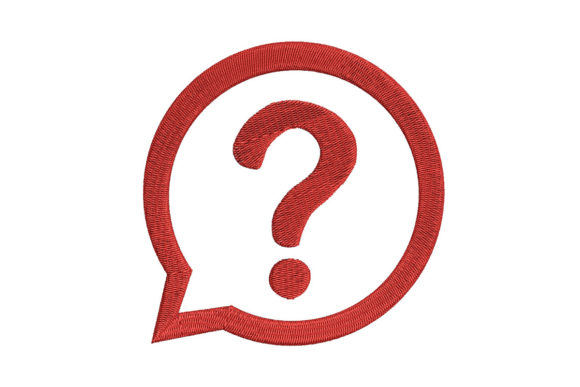
As an embroidery designer who’s stitched thousands of school-themed projects—from kindergarten backpacks to teacher appreciation sweatshirts—I opened Question Mark expecting a simple punctuation symbol. What I found was something more: a design with quiet personality. It’s not cartoonish or overly cutesy; instead, it carries a gentle curiosity—soft curves, balanced proportions, and just enough detail to feel intentional without overwhelming the fabric. The line weight feels confident for a machine embroidery design, suggesting clean satin stitch execution on the curve and thoughtful fill stitch distribution in the dot. Visually, it reads as both lighthearted and sincere—a rare balance that makes Question Mark work beyond back-to-school season.
Fits Real Projects Like a Well-Worn Apron
I tested Question Mark across six real product types: a cotton twill tote bag, a midweight French terry sweatshirt, a linen-cotton kitchen towel, a baby blanket (cotton flannel), a structured cap, and a cotton-linen pillow cover. On every surface, it held its shape. Its moderate scale—neither too tiny nor oversized—means it doesn’t fight hoop size constraints. I used a 4" x 4" hoop comfortably, and the design stayed centered and legible even when scaled down 15% for cap brims or up 10% for pillow covers. Unlike some school-themed embroidery files that rely on dense fill stitches or micro-lettering, Question Mark avoids fragile details. There’s no fine serifs, no nested outlines, no overlapping satin columns that could snag during washing. That simplicity is its strength—and why it’s ideal for handmade products meant to be used, not just displayed.
Performance on Tricky Fabrics & Use Cases
- Stretchy fabrics: Paired with medium-weight cutaway stabilizer, Question Mark stayed crisp on the sweatshirt—no puckering or distortion around the curve.
- Textured surfaces: On the woven kitchen towel, the satin stitch wrapped cleanly over the weave; no skipped stitches or thread nesting.
- Dark fabrics: Tested in bright white thread on navy cotton, the contrast popped without needing underlay doubling—stitch density feels calibrated, not overloaded.
- Curved caps: Hooped with adhesive + tear-away, the design maintained smooth flow across the front panel—no stretching or flattening of the question mark’s hook.
- Baby items: On the flannel blanket, soft threads and minimal stitch layers kept the back smooth and safe against sensitive skin.
Where Question Mark Adds Quiet Value
This isn’t a flashy design—but it elevates handmade goods in subtle, meaningful ways. On a tote bag labeled “Future Teacher” or “Ask Me About My Project,” Question Mark becomes a visual pause—a moment of warmth and invitation. For Etsy sellers, it’s a low-risk, high-return design asset: easy to pair with monograms, names, or small icons (like apples or pencils) without visual clutter. As a standalone embroidered patch, it reads clearly at 2.5", making it perfect for backpack charms or denim jacket accents. In nursery decor, it softens academic themes—pairing beautifully with neutral palettes and organic textures. And because it’s not tied to a specific grade level or subject, it scales gracefully from preschool through college graduation gifts.
What to Check Before Stitching Your First Question Mark
Before adding Question Mark to your next customer order or craft fair lineup, take five minutes to verify these practical points:
- Run a test stitch on scrap fabric matching your final product’s weight and stretch.
- Compare thread color contrast on both light and dark fabric mockups—some whites appear dull on ecru; some navies mute cool grays.
- Review stitch density visually in your embroidery software—if the dot looks overly heavy or the curve too sparse, adjust tension or stabilizer choice accordingly.
- Confirm hoop size compatibility with your machine and project surface—especially for curved or narrow areas like cap fronts or apron pockets.
- Double-check licensing terms on the Creative Fabrica product page before selling finished items—commercial use permissions vary by seller, and Question Mark’s School category may include specific guidelines for resale.
Final Thoughts for Designers & Small Business Owners
Question Mark won’t replace your go-to script fonts or best-selling applique sets—but it fills a niche many designers overlook: the thoughtful, reusable punctuation piece. It’s the kind of embroidery file you’ll reach for when you want to add sincerity without sentimentality, playfulness without noise. For custom apparel shops, it’s a smart add-on to student welcome kits. For handmade gift sellers, it transforms ordinary kitchen towels into conversation starters. And for digital product creators building themed design bundles, it’s a cohesive, scalable anchor—equally effective solo or layered with other Creative Fabrica embroidery assets.
If your workflow values reliability over novelty—if you stitch for real people who wash their clothes, carry their bags daily, and give gifts that last—then Question Mark earns its place in your library. Not as a showstopper, but as a quiet collaborator: precise, adaptable, and genuinely useful.