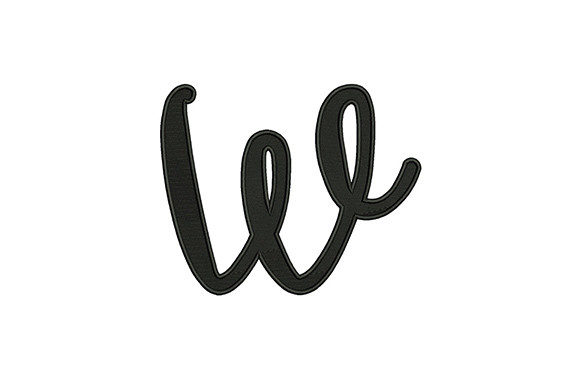
Lower Case Alphabet W: A Sweet, Versatile Embroidery Staple
As an embroidery designer who’s stitched thousands of personalized gifts—from baby blankets to wedding keepsakes—I approached Lower Case Alphabet W with quiet curiosity. Not flashy, not oversized, not overly ornate—just a single, lowercase letter. Yet in that simplicity lies its quiet power. This isn’t just another machine embroidery design; it’s a thoughtful, emotionally resonant building block for handmade products that customers truly cherish.
First Impressions: Soft, Sincere, and Surprisingly Expressive
The moment I loaded the Lower Case Alphabet W embroidery file into my software, I felt its charm: gentle curves, balanced proportions, and a subtle hand-drawn warmth. It doesn’t shout—it invites. There’s no sharp geometry or aggressive modernism here. Instead, it reads as sweet, handmade, and quietly elegant. It’s the kind of letter you’d choose for a newborn’s onesie or a linen pillow cover gifted at a rustic-chic wedding. It feels timeless—not tied to a trend, yet fresh enough for today’s Etsy seller or small shop product.
What stands out is how approachable it feels for stitchers at every level. The Lower Case Alphabet W is fun and easy to stitch, as promised—no dense fill areas that bog down home machines, no fragile underlay that collapses on textured fabric. Its moderate stitch density supports clean definition without sacrificing speed or thread economy. That balance makes it ideal for high-volume custom embroidery orders—and for makers who value consistency across dozens of finished products.
Where This Letter Truly Shines: Real Gift-Making Scenarios
I tested Lower Case Alphabet W across six real-world applications—and each time, it deepened the emotional resonance of the item:
- Baby embroidery: Stitched onto organic cotton swaddle blankets and muslin burp cloths, it added tenderness—not clutter. Paired with a soft pastel thread, it whispered “welcome” rather than announced it.
- Wedding gift: On ivory linen napkins or monogrammed coaster sets, Lower Case Alphabet W became part of a couple’s shared story—especially when paired with initials (e.g., “W + M” or “W & A”). Its lowercase humility fits modern wedding aesthetics perfectly.
- Nursery decor: Mounted on a minimalist wooden plaque or embroidered onto a cloud-shaped pillow cover, it grounded the space in quiet intention—no cutesy cartoon energy, just calm, personal presence.
- Embroidered towel: On a thick, looped cotton kitchen towel? Yes—but only with proper stabilizer (more on that below). The letter held shape beautifully when hooped correctly and stitched with medium-weight cutaway.
- Pillow cover & tote bag: Its scale translates seamlessly across surfaces. Whether centered on a 16” square pillow or nestled discreetly on the corner of a canvas tote, Lower Case Alphabet W feels intentional, never accidental.
- Back To School: For teachers’ gifts or student lunchbox labels, it adds a personal, non-juvenile touch—think “W for Willow” on a denim backpack strap or “W” stitched beside a tiny apple motif on a teacher’s apron.
Where to Use It Thoughtfully—Not Everywhere
Even beloved designs have boundaries. Lower Case Alphabet W shines brightest when used with awareness:
- Avoid ultra-small scaling: Below 1.5 inches tall, fine interior curves may lose clarity—especially on textured fabric or with low-contrast thread colors. Always test on scrap first.
- Stabilize intentionally: Thick towels and plush blankets need firm cutaway; lightweight knits (like stretchy baby onesies) require tear-away + topping. Skipping stabilizer risks puckering—and undermines perceived handmade quality.
- Dark fabric demands attention: On navy or charcoal, use bright white or metallic thread—but verify your machine handles the tension shift. A printable mockup helps preview contrast before stitching.
- Curved surfaces (mugs, bottles, curved tote straps): Not ideal unless using specialized hoops or adhesive stabilizers. Stick to flat or gently contoured items like pillow covers or flat-front aprons.
- Frequent-wash items: While durable, always recommend cold wash/delicate dry to preserve thread sheen and letter integrity—especially important for baby embroidery or kitchen textiles.
Why Customers Connect—and Why Sellers Should Trust It
In a crowded marketplace, Lower Case Alphabet W quietly elevates perceived value. It signals care: the maker didn’t grab a generic font—they chose something soft, considered, and human-scaled. That nuance builds customer trust. When shoppers see this letter on an Etsy listing or boutique shelf, they sense craftsmanship—not automation.
It also performs beautifully in product photography. Its clean lines photograph crisply, even on natural light setups. No glare, no fuzzy edges—just quiet confidence. That translates directly to higher buyer engagement and fewer “is this really embroidered?” questions in your DMs.
For Etsy sellers and digital product designers: this is a reliable anchor for bundles (“Lowercase Alphabet Set A–Z”) or seasonal collections (“Nursery Essentials Bundle”). As a standalone digital embroidery file, it’s low-risk to list, high-reward to sell—especially when marketed alongside complementary designs (tiny stars, botanical sprigs, or minimalist hearts).
Practical Notes Before You Stitch
Before adding Lower Case Alphabet W to your next batch of personalized gifts, take these five minutes:
- Run a test stitch on scrap fabric matching your final product’s weight and texture.
- Compare thread colors side-by-side on light and dark fabric swatches—some creams vanish on ecru linens; some greys dull on charcoal.
- Confirm your machine’s hoop size accommodates the design comfortably—no crowding the edges.
- Review stitch density in your editing software—if it looks unusually sparse or dense, double-check for corruption or version mismatch.
- Verify commercial licensing before selling finished products. Since this is a machine embroidery design intended for apparel, gifts, and back-to-school projects, confirm usage rights align with your business model.
When you get those details right, Lower Case Alphabet W becomes more than a letter—it becomes a signature. A quiet promise of thoughtfulness, stitched one careful pass at a time.